
Guide
Sweepstakes Casinos Explained For US Players in 2026
Sweepstakes casinos let US players spin real casino games without depositing real money, using a two-currency workaround that keeps the whole operation outside state gambling law. If you have ever wondered why sweepstakes operators can run in states where regulated online casinos cannot exist, or how those free Sweeps Coins turn into actual cash prizes, and how the sweepstakes model compares to the real money no deposit bonus shortlist we track for players who prefer direct cash offers, this guide walks through every mechanic that matters and every state carve-out you need to know about before signing up.
 Written by
Patrick John
Last updated:
Written by
Patrick John
Last updated:

What A Sweepstakes Casino Actually Is
A sweepstakes casino is a website that offers slot and table game experiences under US promotional sweepstakes law rather than under state gambling law. You never wager real cash on the games. Instead you play with virtual coins, and one of those coin types can be redeemed for real prizes once you meet a lower playthrough requirement. That structural workaround is why sweepstakes casinos operate in around 33 US states while regulated online casinos exist in only seven. The model has been in place since 2013 when the first sweepstakes-style operators launched, but it has grown into a multi-billion-dollar industry only in the last five years as regulated real-money markets stalled outside a handful of early-adopter states.
Quick reference on the sweepstakes model
| Legal framework | US promotional sweepstakes law, not gambling law |
|---|---|
| Currencies used | Gold Coins (free play) plus Sweeps Coins (prize-eligible) |
| Approximate US state availability | Around 33 states as of 2026, six banned outright, several under legal pressure |
| Minimum age | Usually 18, sometimes 21 depending on operator and state |
| Prize redemption | Cash via bank transfer, Skrill, Amazon or Visa gift cards |
| Typical playthrough on Sweeps Coins | 1x the SC amount (dramatically lower than real-money bonus wagering) |
The best-known sweepstakes operators all follow essentially the same two-currency model, with small variations in coin bundle pricing and minimum redemption thresholds between sites. Once you understand how the two currencies interact, the differences between operators come down to game library depth, coin bundle promotions, and how quickly the KYC and payout processes clear.
Gold Coins vs Sweeps Coins
The dual-currency model is the entire legal trick. Gold Coins are worthless, always. Sweeps Coins have a fixed dollar-equivalent value that you can only unlock through the redemption path. Every mechanic in the sweepstakes model traces back to keeping those two currencies functionally separate. If Gold Coins ever became redeemable, or if Sweeps Coins were ever sold directly, the legal wrapper would collapse and the operation would fall under state gambling law.
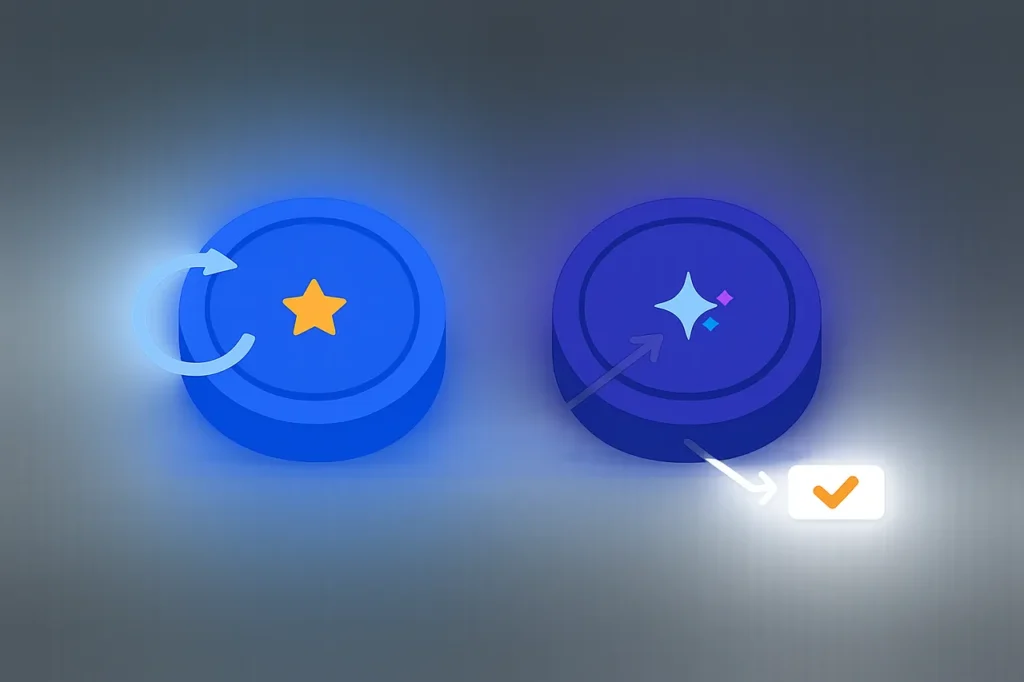
Gold Coins vs Sweeps Coins at a glance
Both currencies spin the exact same games, but only one ever leaves the site as anything of real value.
| Feature | Gold Coins (GC) | Prize-eligible Sweeps Coins (SC) |
|---|---|---|
| Cash value | None, ever | 1 SC roughly equals $1 in cash prizes |
| Purpose | Free entertainment play | Prize-mode play that can be redeemed |
| How you get more | Purchase, daily login, promo drops | Free with GC purchase, signup, mail-in, social contests |
| Playthrough before redemption | Not applicable, cannot be redeemed | Typically 1x the SC amount before withdrawal |
| What players actually chase | Fun, exploration, testing new games | Redeemable prize winnings |
| Balance expiry | Never expires at most operators | Never expires at most operators |
Both coin types feed into the exact same games. A Pragmatic Play slot on any sweepstakes site plays identically whether you bet with GC or SC, using the same RTP tables and the same random number generator. The distinction is not gameplay, it is legal wrapper. Gold Coins keep the site inside promotional sweepstakes law by having no cash value. Sweeps Coins can only be given away as prizes or bundled with GC purchases, never sold directly, which keeps them outside gambling law too. If an operator ever sold SC directly, the site would immediately become a real-money casino and be subject to state gambling regulation.
How You Get Free Sweeps Coins Without Buying Anything
Because Sweeps Coins cannot be sold directly under US sweepstakes law, every legitimate operator has to offer at least one no-purchase method of obtaining them. That is why the mail-in request exists and why every site publishes a mailing address in their terms of service. Free SC also drops from signup bundles, social contests, referrals and daily login streaks. In practice, a patient player can accumulate meaningful Sweeps Coins without ever spending a dollar, and many do exactly that.
Six free ways to get Sweeps Coins
Every operator supports most of these methods. The specific amounts vary from site to site.
-
Signup bundle
Every operator gives new accounts a starter package of Gold Coins plus a small amount of Sweeps Coins, usually one to five SC, no purchase needed. The leading sites top the market at around 25 free SC on signup as of 2026.
-
Daily login rewards
Log in for consecutive days and receive escalating GC plus small SC drops. Streaks reset on missed days at most operators, though some now offer a grace period.
-
Social media contests
Follow the operator on X, Facebook or Instagram and comment or share to enter contests that award SC. These run several times per week at the bigger sites and are the fastest free path to a meaningful SC balance.
-
Referral programme
Refer a friend who signs up and verifies, and receive an SC bonus once they make their first purchase or complete KYC. Referral bonuses typically range from 5 SC to 25 SC per successful referral.
-
Mail-in request
Handwrite a request on a 3×5 card and mail it to the operator address listed in their terms. Each valid request returns a small SC award (typically 5 SC) with a monthly cap. Every operator must offer this method by US sweepstakes law.
-
GC purchase bundles
Every GC bundle comes with bonus SC included at no additional cost. This is the primary paid path, but the SC is technically free because you are only paying for the GC.
What Redemption Actually Means And How It Works
Sweeps Coin redemption is where the dual-currency model turns virtual back into real. It is a controlled process with three gates, and understanding those gates is the difference between accumulating SC forever and actually walking away with cash. Every legitimate US sweepstakes operator uses essentially the same three-gate structure, with minor variations on the specifics.

The three redemption gates
Every SC redemption at every operator passes through these three steps in order.
-
Playthrough (typically 1x)
Before an SC balance can be withdrawn, each Sweeps Coin must be bet at least once in prize-mode play. This is dramatically lower than the 30x to 50x wagering common at real-money bonuses, and the SC balance stays intact while you clear it. You are just recycling the same balance through spins.
-
KYC identity verification
You submit a government ID (drivers licence or passport), proof of address (utility bill or bank statement) and sometimes a selfie. Verification is enforced strictly and applies before your first payout, not on every subsequent one. Documents clear within one to five business days at most operators.
-
Payout to your linked account
Once verified you pick a payout method: ACH bank transfer, Skrill, or in some cases Amazon or Visa gift cards. Bank transfers land within one to five business days. Gift-card payouts usually clear same day. The redemption request stays pending in a queue during business hours and is processed manually by an operator team, which is why weekends can slow things down.
Minimum redemption thresholds by operator
Most operators enforce a minimum SC balance before you can request redemption. This is usually somewhere between 20 SC and 100 SC (roughly $20 to $100). Thresholds across the market range from 20 SC (the lowest) up to 100 SC, with most sites clustered between 30 SC and 50 SC. Requests under the threshold are declined until you accumulate more, but the balance never expires so you can keep building slowly. Higher-tier VIP players sometimes unlock reduced minimums as a loyalty perk.
Where Sweepstakes Casinos Are Legal In The US
Because sweepstakes casinos operate under sweepstakes law rather than gambling law, they can offer their model in states where regulated online casinos cannot exist. That said, several states have carved out exceptions or banned the model outright, and the landscape has shifted noticeably since 2024. Every operator geo-blocks based on your IP address, so eligibility is enforced automatically, and attempting to VPN around a state ban voids any Sweeps Coin balance you build.

US sweepstakes casino state status in 2026
| Fully allowed | Around 33 states, including CA, NY, TX, FL, IL, PA, GA, NC, OH, VA and most of the Midwest |
|---|---|
| Fully banned | Washington (long-standing), Idaho, Michigan (2024), Nevada, Louisiana (2025), Alabama |
| Operator-specific restrictions | Some operators decline players in NY, NJ, PA due to regulator pressure even where the model is technically legal |
| Age gates | 18+ default, 21+ in AL, HI, MA and enforced by some operator terms |
| Recent state action | Louisiana AG issued cease-and-desist letters in 2025, Michigan banned outright in late 2024 |
Michigan and Louisiana represent the first serious state-level challenges to the sweepstakes model. Michigan banned outright in late 2024 after the Michigan Gaming Control Board argued the SC redemption path amounts to gambling in substance regardless of legal framing. Louisiana followed in 2025 with cease-and-desist letters to major operators. Other state AGs are watching and could follow depending on how the Michigan case plays out in court. If you are in a currently-allowed state, expect the list of allowed states to keep shrinking modestly over the next 12 to 24 months. For the broader picture of which states allow which forms of online casino play, see our US legal map.
The Purchase-Bundle Mechanic
If Sweeps Coins cannot be sold directly, how do sweepstakes operators make money? The answer is the Gold Coin purchase bundle. You buy GC (which has no cash value and cannot be redeemed) and receive a bonus of free SC on top. Legally you are paying only for the GC. The bundled SC is a promotional gift attached to the transaction. Structurally, of course, the SC is why you are buying, and operators price the bundles with that dynamic in mind.
Typical bundle pricing tiers
Bundle economics vary by operator but follow a consistent pattern. A $9.99 bundle typically returns 100,000 GC plus 10 SC. A $19.99 bundle returns 200,000 GC plus 25 SC. A $49.99 bundle returns 500,000 GC plus 70 SC. A $99.99 bundle returns 1,000,000 GC plus 150 SC. First-purchase discounts frequently apply, giving new accounts up to 200% extra SC on their first bundle for a 48-hour window. The GC amount alone at these price points is meaningless (nothing to redeem), so the effective cost of the SC works out to roughly $0.60 to $1.00 per SC depending on the tier.
Effective SC pricing by bundle tier
| $9.99 bundle | 100,000 GC + 10 SC → roughly $1.00 per SC |
|---|---|
| $19.99 bundle | 200,000 GC + 25 SC → roughly $0.80 per SC |
| $49.99 bundle | 500,000 GC + 70 SC → roughly $0.71 per SC |
| $99.99 bundle | 1,000,000 GC + 150 SC → roughly $0.67 per SC |
Sweepstakes Casinos vs Real-Money Casinos
If you live in New Jersey, Pennsylvania, Michigan, West Virginia or one of the other regulated states, you have the choice between a regulated real-money casino and a sweepstakes casino. The correct choice depends on your goals. Sweepstakes casinos are better for casual free-play and for players outside the regulated states. Regulated real-money casinos are better for players who want higher-stakes play, faster payouts, and access to no-deposit bonuses with real dollar amounts.
Sweepstakes vs regulated real-money
Both let you spin slots, but the mechanics and player fit diverge sharply.
| Feature | Nationwide Sweepstakes casino | 7 states Regulated real-money |
|---|---|---|
| US state availability | Around 33 states | 7 states only |
| Playthrough on prize funds | 1x typical on SC | 1x to 40x on bonuses, 0x on real deposits |
| Bonus offer structure | GC bundles plus free SC daily | Cash NDBs, deposit matches, free spins |
| Withdrawal speed | 1 to 5 business days after KYC | Same-day PayPal or instant methods at leading operators |
| Bet-size range | Fractional SC bets, no high-roller tier | Full range including high-roller tables |
| Best for | Casual free-play, players outside regulated states | Regular players inside regulated states |
How To Pick A Trustworthy Sweepstakes Casino
Not every sweepstakes site is well-run. A few smaller operators have shut down mid-cycle over the past three years, leaving player balances stranded. The good news is that the top six or seven operators have been running for years and have paid out publicly documented redemption with Reddit and Trustpilot trails to back it up. Use these criteria to filter, and stick to established brands unless you have a specific reason to try a newer site.
Trust checklist
- Operator has been running at least three years with public redemption records
- Minimum redemption threshold under 100 SC (lower is better)
- Multiple payout methods including bank transfer
- Clear mail-in address published in terms
- Game library from named providers (Pragmatic Play, Hacksaw, Relax Gaming, Betsoft, Playson)
- Under one year in operation with no independent reviews or Reddit trail
- Minimum redemption above 200 SC
- No mail-in address published or requires payment for entry
- Unnamed or offshore game providers only
- Reddit or Trustpilot complaints about stalled redemption over multiple months
Our shortlist of sweepstakes casino no deposit bonuses filters by all of the criteria above, cross-checks minimum redemption against advertised SC amounts, and pulls Reddit sentiment scores from the last six months. Every operator on the list has processed real player redemptions with documented Reddit and Trustpilot proof. Players who want both sweepstakes and cash options in one view can compare them on our top no deposit bonus picks.
Frequently Asked Questions About Sweepstakes Casinos
In most states, yes. The sweepstakes model operates under US promotional sweepstakes law rather than gambling law, which is why it works in around 33 states. A handful of states (Washington, Idaho, Michigan, Louisiana, Nevada, Alabama) have banned or restricted the model, and operators geo-block based on your IP. If a site accepts your signup, it is legal in your state as far as the operator can determine.
Yes, once you clear the 1x playthrough and complete KYC verification. Payout options vary by operator but usually include ACH bank transfer, Skrill, and Amazon or Visa gift cards. Bank transfers typically arrive within one to five business days after verification. First redemptions are slower because of the KYC step, subsequent ones are faster.
Yes. The games use the same slot software and RTPs as real-money casinos (typically 94% to 96%), meaning house edge is 4% to 6% per spin. On free-only SC play the edge is irrelevant because you have zero cost basis. On purchased SC bundles, the edge shapes long-run expected value.
Every operator publishes a mailing address in their terms of service. Handwrite a request on a 3×5 card following the operator format and mail it in. You receive a small SC award (typically 5 SC) per valid request, capped at a monthly limit. It is real, legal and required by US sweepstakes law, but the labour-to-reward ratio only makes sense for the truly free-only crowd.
The KYC verification stage is the longest, usually one to five business days depending on operator backlog. Once verified, gift card payouts often clear same day, and bank transfers land in one to five business days. First-time redemptions take longest because verification is fresh.
Yes, and it is common. Each operator has its own signup bundle and daily rewards, so most players juggle three or four accounts. Duplicate-account rules apply within a single operator (you cannot open two accounts at any single operator) but not across operators.
Yes. Prize winnings redeemed from sweepstakes casinos are taxable income under US federal law. Operators issue 1099 forms if you clear $600 in redemption over the calendar year. State tax treatment varies. Winnings under the threshold are still legally taxable, the operator just does not report them.